
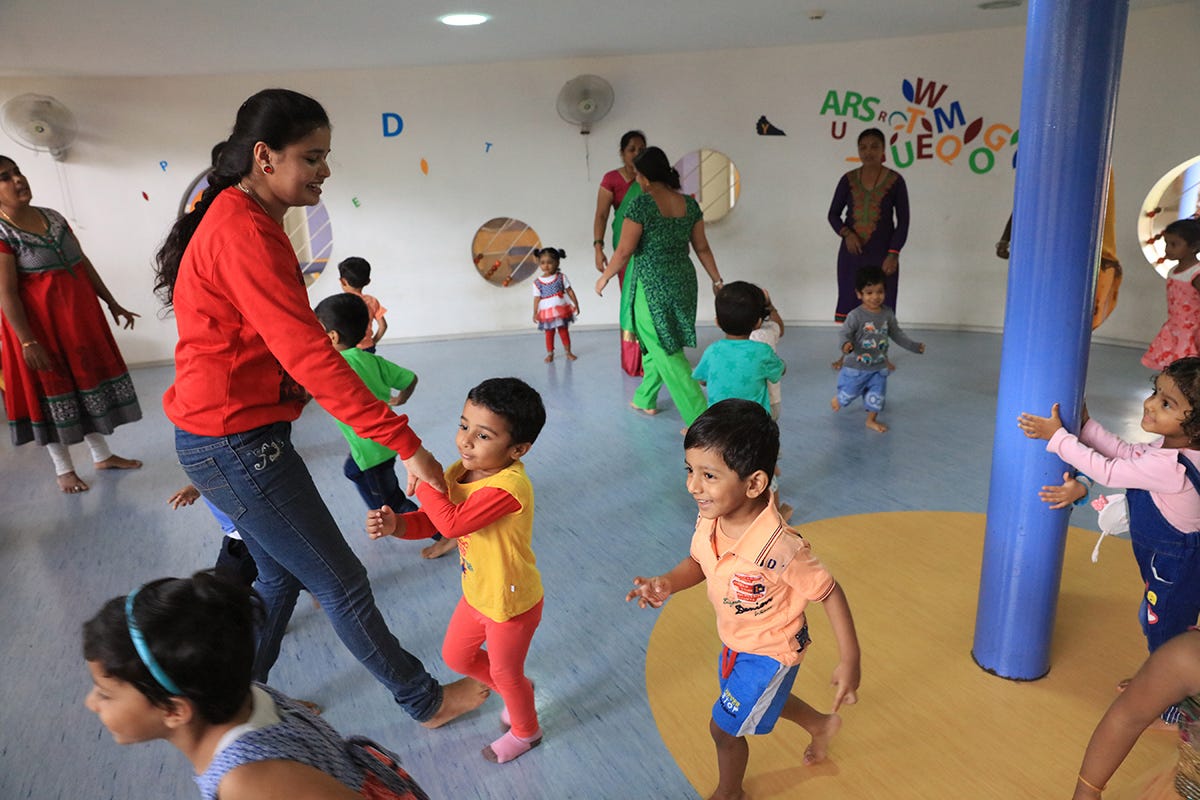
of the National Minimum Standards and Protocol for Crèches (Operation and Management)
in March 2024. Issued by the Ministry of Women and Child Development (MWCD), this protocol
aims to standardize childcare services across sectors, ensuring that working parents—both
mothers and fathers—have access to safe and high-quality crèche facilities.
A Mandatory Requirement for CPSEs
The Department of Public Enterprises (DPE) has mandated that all Central Public Sector
Enterprises (CPSEs) comply with these new standards. This directive builds upon a 2009 Office
Memorandum which first made crèche facilities mandatory near workplaces to support employees
with pre-school or primary-school-going children.
By institutionalizing care services, the government aims to increase female labor force
participation while enabling employees to better balance professional and family
responsibilities.
Key Features of the 2024 Protocol
The 2024 protocol introduces a comprehensive operational framework that moves beyond basic
supervision toward a holistic rights and development approach for early childhood care.
1. Administrative and Operational Framework
- Target Group: Children from 6 months of age onwards.
- Mandatory Provision: Crèche facilities are mandatory in CPSEs and offices where
employees—both male and female—have pre-school or primary-school-going children. - Location: Crèches should ideally be located near the child’s home or parents’
workplace and preferably on the ground floor for accessibility and safety. - Timing: Operating hours are flexible and decided mutually between parents and
the crèche administration. - Administrative Committee: Each crèche must have a committee comprising a
Crèche Administrator, a Crèche Supervisor, and at least three parents or guardians.
2. Staffing and Resource Requirements
- Staffing Ratio: One supervisor and one helper for every 20–25 children.
- Qualifications:
- Supervisors must have passed at least the 12th grade.
- Helpers must have passed at least the 10th grade.
- Preference for candidates with diplomas in Childcare or Nursing and a minimum of two years’
experience.
- Gender: Only women staff are to be recruited as caregivers.
- Hiring Prerequisites: Police verification, character certificate, and medical
certificate are mandatory.
3. Infrastructure and Safety Standards
- Facility Design: Adequate space, ventilation, lighting, and fenced windows at
safe heights. - Sanitation: Child-friendly toilets with running water, soap, and inclusive
design for specially-abled children. - Security: Mandatory CCTV installation with remote monitoring access for
parents wherever possible. - Inspections: Regular safety inspections by the Administrative Committee and
quarterly community-based inspections.
4. Health and Holistic Development
- Health Services: Maintenance of medical records and tie-ups with nearby health
facilities for emergencies. - Learning Materials: Age-appropriate toys, educational activities, and sports
kits to support cognitive and physical development. - Nutrition: Food arrangements decided through mutual agreement between parents
and the crèche administrator.
5. Essential On-Site Items
- Health: Weighing scales, thermometers, growth monitoring devices, first aid
kits. - Hygiene: Soap, sanitizers, spin mops, and covered dustbins.
- Learning & Toys: Fixing blocks, dolls, kitchen sets, stringing beads, and
learning kits. - Safety: Fire extinguishers, torches, and CCTV cameras.
- Miscellaneous: Beds, cradles (palna), round tables, and storage cabinets.
References
Ministry of Finance, Department of Public Enterprises. (2024, March 4). National Minimum
Standards and Protocol for Crèches (Operation and Management). Government of India.
Ministry of Heavy Industries and Public Enterprises, Department of Public Enterprises. (2009,
August 17). Setting up of crèches near workplaces and in the offices of PSEs. Government
of India.
Ministry of Women and Child Development. (2024, February 23). National Minimum Standards
and Protocol for Crèches. Government of India.
Garghate, R., & Choudhari, S. (2024). Health policies and guidelines to promote, protect and
support early childhood development: A narrative review.
Journal of Family Medicine and Primary Care, 13(9), 3502–3508.